
Slot Volatility Explained: Low, Medium and High-Risk Games
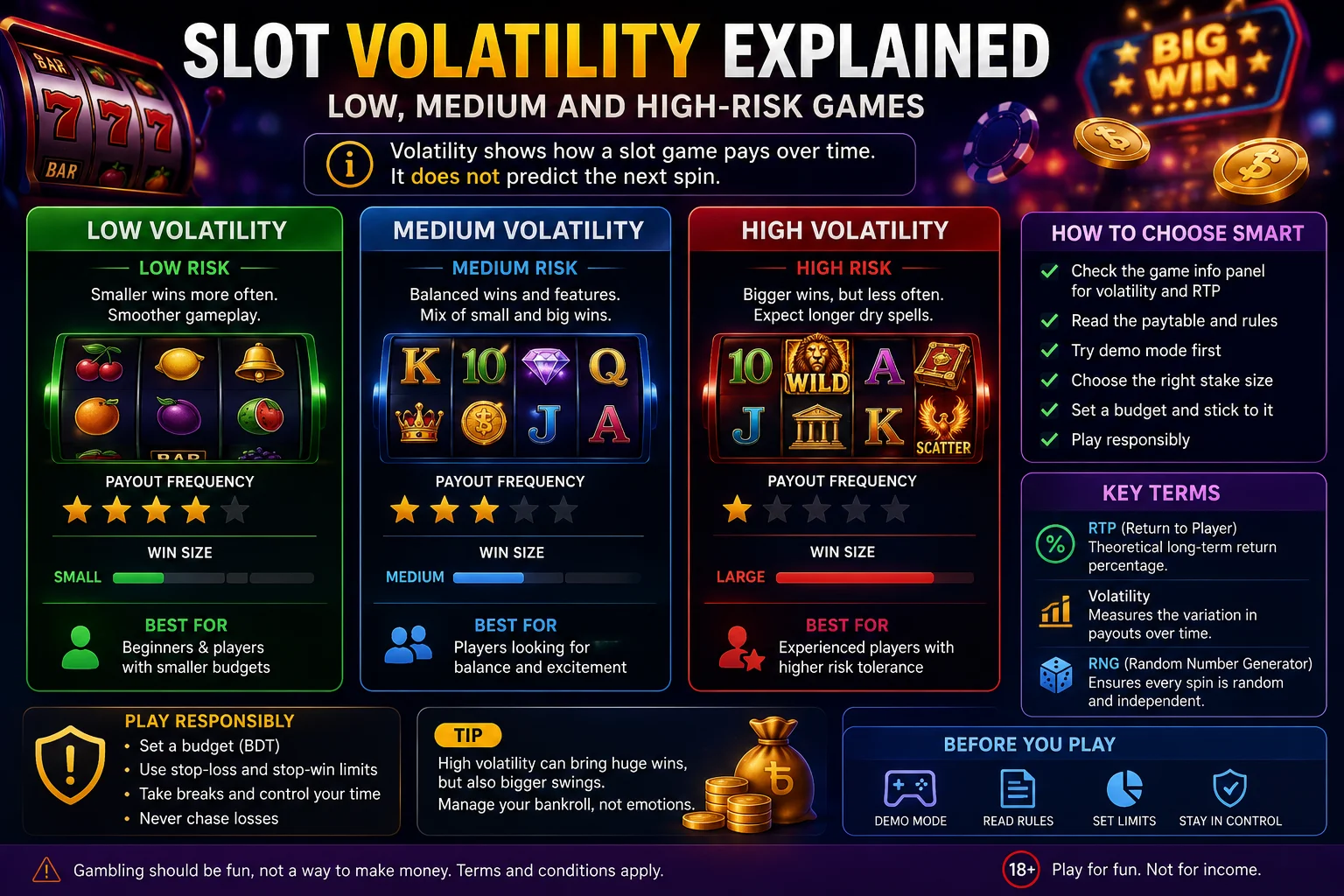
Slot Volatility Explained at Pin Up Bangladesh is an informational blog guide for Bangladesh users who want to understand low, medium and high-risk slot games before choosing a title, checking demo mode, or setting a BDT budget. Volatility shows payout rhythm; it does not predict the next spin.
The simple idea is this: low-risk slots usually feel steadier, medium-risk slots sit between steady and swingy play, and high-risk slots can create longer gaps with sharper payout swings. “Risk” here means session volatility and bankroll pressure, not guaranteed loss, guaranteed win, legal safety, or game quality.
Quick Answer: What Is Slot Volatility?
Slot volatility describes how uneven a slot’s payouts may feel over time. Low volatility usually means smaller wins appear more often, while high volatility usually means larger prizes may be rarer and balance swings can feel stronger.
The UK Gambling Commission describes volatility as commonly represented by standard deviation. It explains that highly volatile games may include “very large but rare” prizes, while low-volatility games are more associated with “small and often” prizes. This is used as a general technical reference, not as a claim about Pin Up Bangladesh licensing.
| Volatility label | Common session feel | Main BDT risk | Best first check |
|---|---|---|---|
| Low risk / low volatility | Smaller wins more often | Playing too long because the game feels steady | Time limit |
| Medium risk / medium volatility | Mixed rhythm of small and larger results | Misreading short swings as a pattern | Stake size |
| High risk / high volatility | Longer gaps and sharper swings | Chasing features or increasing stake after losses | Stop-loss |
| Unknown volatility | Not confirmed in the panel | Guessing based on theme or visuals | Demo and paytable |
Low-Risk Slots Explained
Low-risk slots usually create a smoother session rhythm. They may show more frequent small wins, simpler mechanics, or less dramatic feature gaps, depending on the game.
This does not make low-risk slots “safe.” A small win can still be smaller than the stake used to get it. A session can still lose BDT if the user keeps spinning beyond the planned time or budget. Low volatility mainly reduces the feeling of heavy swings; it does not remove randomness.
Low-risk slots may suit users who:
- want to learn slot rules slowly;
- prefer smaller session swings;
- use a limited BDT budget;
- dislike long dry periods;
- want clearer paytable reading;
- are testing demo mode before real play.
Low-risk slots may not suit users who:
- expect large feature wins quickly;
- mistake frequent small wins for profit;
- keep playing because the game feels comfortable;
- ignore total spend over time;
- use autoplay without a session limit.
Medium-Risk Slots Explained
Medium-risk slots usually balance frequent smaller wins with occasional stronger swings. They can be useful for users who understand basic paylines, RTP, volatility, and bonus rules but do not want the sharpest high-volatility pressure.
Medium volatility is often the hardest category to judge from visuals alone. A game may look simple but still create uneven results. Another game may look feature-heavy but feel moderate in demo mode. The live game panel, paytable, volatility label, RTP note, and provider rules should be checked before making assumptions.
| Medium-risk signal | What it may suggest | What to confirm |
|---|---|---|
| Mix of base-game wins and bonus features | Balanced session rhythm | Bonus trigger and payout rules |
| Moderate feature frequency | Less extreme than high volatility | Volatility label if shown |
| Clear stake range | Easier BDT planning | Total bet per spin |
| Free spins or multipliers | Extra feature potential | Bonus eligibility and restrictions |
| Demo rhythm feels mixed | Useful learning signal | Demo does not predict real play |
High-Risk Slots Explained
High-risk slots usually create the strongest bankroll pressure. They may include rare bonus features, large multipliers, jackpot-style mechanics, bonus buys, or large maximum win potential if shown.
The main danger is emotional. A user may think the game is “due” after many losing spins, or may increase stake size because a bonus feels close. That is not a reliable reading. High volatility means the session can be uneven; it does not mean a large win is approaching.
High-risk slots may suit only users who:
- accept that long dry periods can happen;
- set a strict BDT stop-loss;
- choose small stakes relative to session budget;
- understand the paytable and feature rules;
- avoid chasing free spins or bonus buys;
- stop when the plan says to stop.
High-risk slots may not suit users who:
- have a small BDT balance;
- get frustrated quickly;
- raise stakes after losses;
- chase scatters, multipliers, or free spins;
- treat near misses as signals;
- use essential money.
Low, Medium and High-Risk Slots Compared
The main difference is how the game can pressure your balance and patience. Low-risk games can encourage long sessions, medium-risk games can create mixed signals, and high-risk games can produce sharp swings.
| User question | Low risk | Medium risk | High risk |
|---|---|---|---|
| Are wins usually frequent? | More often | Mixed | Less often |
| Are wins usually large? | Usually smaller | Mixed | Potentially larger but rarer |
| Can the BDT balance drop quickly? | Yes, but often more gradually | Yes | Yes, especially with larger stakes |
| Is the game easy for beginners? | Often easier | Depends on rules | Usually harder |
| Is RTP still important? | Yes | Yes | Yes |
| Is demo mode useful? | Yes | Yes | Very useful |
| Main mistake | Playing too long | Misreading short swings | Chasing features |
Volatility Is Not the Same as RTP
RTP and volatility answer different questions. RTP explains the theoretical long-term return model, while volatility explains the shape of results along the way.
The UK Gambling Commission defines theoretical RTP as the designed return-to-player percentage shown in player-facing rules and actual RTP as a figure calculated from win and turnover data over a measured period. It also separates volatility as a measure of payout variation.
| Term | What it explains | What it does not explain |
|---|---|---|
| RTP | Long-term theoretical return model | What your next spin will do |
| Actual RTP | Past measured performance over selected data | Your personal future result |
| Volatility | Payout rhythm and swing size | Whether the game is “due” |
| Hit frequency | How often wins may appear | Whether those wins create profit |
| Max win | Highest possible result if stated | A realistic expectation for a session |
A high-RTP slot can still be high volatility. A low-volatility slot can still reduce your balance. The safest reading is to check RTP and volatility together, then decide whether the stake fits your BDT budget.
Why Past Spins Do Not Predict Future Spins
Previous spins should not be treated as signals. A slot is not due after losses, and a recent win does not make the next spin safer or worse.
The UK Gambling Commission’s random-outcome standard says RNG output and game results should be acceptably random, distributed according to expected or theoretical probabilities, and unpredictable; it also says adaptive behaviour that changes probabilities during play is not permitted in that regulatory context.
Avoid these common myths:
- “A high-risk slot must pay soon.”
- “Low-risk slots cannot lose fast.”
- “A near miss means free spins are close.”
- “Manual spins are luckier than autoplay.”
- “The slot pays more at night.”
- “Increasing the stake unlocks better outcomes.”
- “Demo mode proves what real-money play will do.”
How to Check a Slot’s Risk Level
The live game panel is the best place to check volatility. Do not rely only on theme, animations, social posts, screenshots, or old reviews.
Use this checklist before real play:
- Open the slot information panel.
- Check whether volatility or risk level is listed.
- Check RTP if shown.
- Read the paytable.
- Confirm paylines, ways, clusters, or other win rules.
- Check minimum and maximum stake in BDT.
- Read wild, scatter, and free spin rules.
- Check bonus buy or gamble feature rules if shown.
- Test demo mode if available.
- Skip real play if the rules are unclear.
What If Volatility Is Not Listed?
If volatility is not listed, do not state it as a fact. You can use cautious signals, but the safest wording is to tell users to check the live panel or provider notes.
Possible soft signals include feature frequency, paytable structure, maximum win label if shown, bonus buy availability, and demo rhythm. These signals can help users understand how a game feels, but they do not confirm volatility unless the provider or live panel says so.
| Unconfirmed signal | Possible reading | Caution |
|---|---|---|
| Frequent small wins in demo | May feel lower risk | Demo is not proof |
| Rare feature trigger | May feel higher risk | Short demo samples can mislead |
| Large multiplier features | May increase swings | Rules matter |
| Bonus buy option | Can increase session pressure | Bonus terms may restrict it |
| Jackpot-style feature | Often uneven | Jackpot terms must be checked |
| Simple paytable | Easier to read | Not proof of low volatility |
Demo Mode for Slot Volatility
Demo mode helps you learn the rhythm, not predict results. It is useful for checking whether the slot feels too fast, too complex, or too swingy before using BDT.
Use demo mode to answer practical questions:
- Are the paylines or ways clear?
- Does the game show volatility or RTP?
- How fast do spins move?
- Are small wins easy to distinguish from net profit?
- What triggers the bonus feature?
- Are there bonus buys or gamble features?
- Is autoplay available?
- Does the game feel suitable for your budget?
- Is the mobile screen readable?
- Do you understand the paytable?
If demo mode is missing, check the lobby, device, account mode, provider settings, and game panel. Availability may vary by title, account, region, device, and current platform settings.
Low-Risk Slot Budgeting in BDT
Low-risk slots need strict time control. Because the session may feel smoother, users can stay longer than planned and spend more total BDT over time.
Low-risk budgeting checklist:
- Set a fixed BDT session budget.
- Set a time limit before the first spin.
- Track total spend, not just winning spins.
- Keep stake size small and consistent.
- Do not raise stakes because the game feels stable.
- Stop at the planned time.
- Do not treat frequent small wins as income.
Medium-Risk Slot Budgeting in BDT
Medium-risk slots need balanced stake control. The user should prepare for both small returns and uneven patches.
Medium-risk budgeting checklist:
- Set a BDT session budget before play.
- Choose a stake that allows enough spins.
- Set a stop-loss before the first spin.
- Set a stop-win and leave when reached.
- Test demo mode if available.
- Avoid increasing stake after short losing runs.
- Avoid chasing a feature because it appeared once in demo.
High-Risk Slot Budgeting in BDT
High-risk slots need the strictest stop-loss. The main risk is spending too much while waiting for a rare feature.
High-risk budgeting checklist:
- Use a smaller stake relative to your total budget.
- Set a strict BDT stop-loss.
- Set a stop-win before play.
- Avoid bonus buys while learning.
- Avoid autoplay if it speeds up losses.
- Do not deposit again because a feature feels close.
- Stop if frustration affects your stake size.
- Do not use essential money.
Bonus Terms and Slot Risk
Bonus terms can change how risky a slot session feels. A high-risk slot may make wagering harder because results can swing sharply, while a low-risk slot may take longer and still fail to meet expiry or contribution rules.
Before using bonus funds or free spins, check:
- eligible games;
- wagering contribution;
- maximum bet while wagering;
- expiry time;
- maximum win cap if stated;
- balance order;
- free spin value;
- bonus buy restrictions;
- gamble feature restrictions;
- jackpot restrictions;
- withdrawal conditions.
Do not assume that low, medium, or high-risk slots all count the same toward wagering. If a specific game is not named as eligible, confirm through verified support channels or avoid using bonus funds on it.
Slot Risk and Autoplay
Autoplay can make volatility harder to manage. It can move through spins faster than a user can evaluate balance, time, and emotional state.
Autoplay is especially risky when:
- the slot is high volatility;
- the user has no stop-loss;
- bonus buys are available;
- the user is chasing free spins;
- the session budget is small;
- the user is tired or emotional;
- the mobile connection is unstable;
- the game’s win display is hard to read.
Set limits first, or avoid autoplay while learning the game.
Mobile and APK Safety
A separate “slot risk” or “volatility checker” APK is usually not needed. Use the verified Pin Up mobile site or official app source if available in your current environment and permitted in your location.
Avoid third-party APKs that promise:
- guaranteed high-RTP slots;
- volatility hacks;
- free spin predictors;
- bonus trigger scanners;
- low-risk slot lists with secret access;
- RNG manipulation;
- withdrawal bypass.
Be cautious if an app asks for SMS access, contacts access, accessibility permissions, overlay permissions, banking/payment app access, or permission to read verification codes. These permissions can expose users to phishing, malware, stolen login details, SMS code theft, and payment data theft.
Cashier Checks Before Real Play
Cashier details must be confirmed inside the live account. Do not assume that any payment method, fee, minimum deposit, minimum withdrawal, or processing time is available at Pin Up Bangladesh unless it appears in the current cashier.
| Cashier item | What to confirm | Why it matters |
|---|---|---|
| Account currency | BDT or current account currency | Avoid currency confusion |
| Deposit method | Visible in live cashier | Methods can vary |
| Withdrawal method | Visible in live cashier | Not every deposit method may withdraw |
| Minimum deposit | Current cashier value | Old guides may be outdated |
| Minimum withdrawal | Current cashier value | Avoid failed withdrawal attempts |
| Processing time | Current cashier note | Timings can vary |
| Fees | Shown before transaction | Avoid surprise deductions |
| Name match | Account and payment holder | Helps reduce verification issues |
| Bonus balance | Whether it blocks withdrawal | Wagering may apply |
| KYC trigger | Whether documents may be required | Prevents withdrawal surprises |
KYC and Slot Withdrawals
KYC may be required before withdrawal or account review. Volatility level does not change verification requirements.
Use your real name and correct date of birth. Keep payment accounts in your own name. Prepare a government ID if requested, and prepare proof of address if the account tools request it. Upload documents only through official account tools. Do not edit documents, do not send documents through social media, and stop depositing if withdrawal is blocked for verification.
Low, Medium and High Risk: Which Should Beginners Choose?
Beginners usually understand low or medium-risk slots more easily. The reason is not that these games guarantee better outcomes. They usually create less emotional pressure than high-risk titles.
| User situation | Better starting point | Why |
|---|---|---|
| First time learning slots | Low risk or demo mode | Easier to observe rules |
| Small BDT budget | Low or medium risk if confirmed | More room for stake control |
| Wants feature-heavy gameplay | Medium risk first | Less pressure than high-risk games |
| Gets frustrated quickly | Low risk or no real play | High-risk dry periods can trigger chasing |
| Does not understand paytable | Demo only | Real play should wait |
| Uses strict limits | Any type with caution | Budget rules matter most |
Slot Risk and Game Types
Themes do not prove volatility. Fruit, book, fantasy, animal, jackpot, Megaways-style, classic, and video slots can all vary by title and provider.
A book slot is not automatically high risk. A fruit slot is not automatically low risk. A classic slot is not automatically safer than a video slot. The only practical way to compare is to check the live panel, paytable, volatility label if shown, RTP if shown, and bonus rules.
| Slot style | What users may assume | Safer reading |
|---|---|---|
| Fruit slots | “Simple means low risk” | Check volatility and paytable |
| Book slots | “Bonus feature means high risk” | Confirm title-specific rules |
| Megaways-style slots | “More ways means easier wins” | Ways count does not guarantee profit |
| Jackpot slots | “Large prize means better value” | Jackpot prizes can be rare |
| Classic slots | “Old-style means safer” | Random outcomes still apply |
| Video slots | “More features means better” | Features can increase chasing risk |
Troubleshooting Slot Risk Issues
Most slot problems should be checked through the game panel, balance history, bonus terms, and official support. Do not install random APKs or browser extensions to “fix” a game.
| Problem | What to check | What to avoid |
|---|---|---|
| Volatility missing | Info panel, paytable, provider notes | Guessing the risk label |
| Demo mode missing | Lobby, account mode, device, provider settings | Treating demo absence as a real-money signal |
| Bonus not counting | Eligible games, contribution, max bet | Continuing before reading terms |
| Balance drops quickly | Stake size, volatility, stop-loss | Depositing again immediately |
| Game freezes | Connection, balance history, official support | Third-party repair APKs |
| Withdrawal delayed | KYC, name match, cashier status, bonus balance | More deposits while blocked |
Responsible Gaming for Slot Volatility
Slot volatility should be treated as a risk-control signal, not a strategy. The Responsible Gambling Council advises users not to chase losses, not to gamble to replace income, to set time and spending budgets before play, to use loss and win limits, and to take breaks.
Use these rules before any slot session:
- treat slots as entertainment, not income;
- meet age and local legal requirements;
- set a fixed BDT budget;
- set a stop-loss;
- set a stop-win;
- set a time limit;
- avoid chasing losses;
- avoid feature chasing;
- be careful with autoplay;
- avoid bonus buys while learning;
- take breaks;
- stop if the game stops feeling fun;
- use cooling-off, deposit limits, session reminders, or self-exclusion tools where available.
Legal Notice for Bangladesh
Real-money slot access in Bangladesh must be treated cautiously. This page should not be read as a claim that online casino play, slot access, or real-money gambling is legal, available, or allowed nationwide.
The official Bangladesh laws portal lists the Cyber Protection Act, 2026, dated April 10, 2026. Section 20 concerns gambling in cyberspace and refers to participation, operation, assistance, encouragement, advertising, and direct or indirect promotion, with penalties stated in the section. Users should check current law, platform access, account terms, and local restrictions before any transaction.
Common Mistakes With Slot Volatility
Most volatility mistakes happen when users treat risk labels as predictions. Low risk does not mean guaranteed steady profit, and high risk does not mean a big win is due.
Avoid these mistakes:
- choosing a game only by theme;
- assuming low risk means no real risk;
- choosing high risk with a very small BDT budget;
- ignoring RTP;
- ignoring the paytable;
- treating previous spins as signals;
- using bonus funds without checking eligible games;
- chasing free spins after many losses;
- using autoplay without limits;
- installing volatility-predictor APKs;
- depositing again while KYC or withdrawal is unresolved;
- continuing after the stop-loss or time limit.
Final Takeaway
Slot volatility explains payout rhythm and bankroll pressure. Low-risk games usually feel steadier, medium-risk games create mixed sessions, and high-risk games can produce sharper swings.
For Pin Up Bangladesh readers, the safer approach is simple: check the live game panel, read the paytable, confirm RTP and volatility if shown, test demo mode where available, use a fixed BDT budget, review bonus terms, and stop when the planned limit is reached.